Tribulus Terrestris in Apex Boost: What the Research Actually Shows
Tribulus terrestris is the first herb listed in Apex Boost's 838 mg Proprietary Male Support Blend. Human trials on tribulus are mixed: a small randomized trial found it improved erectile-function scores versus placebo, while a separate controlled study in healthy young men found it did not raise testosterone or other androgens. The label does not print how many of the 838 mg come from tribulus specifically, so neither finding can be matched to a known dose in this product.
What tribulus terrestris is
Tribulus terrestris, also called puncture vine, is a flowering plant that grows in warm climates across the Mediterranean, India and China. Traditional Ayurvedic and Chinese herbal practice used extracts of its fruit as a general tonic, and it has since become one of the most common single ingredients in commercial men's-health and sports-nutrition blends, usually marketed around libido, vitality or "male support" claims.
Most commercial tribulus extracts are standardized, when they are standardized at all, to a percentage of saponins — a class of plant compounds believed to be behind whatever biological activity the plant has. The problem for anyone trying to evaluate a product is that "tribulus extract" on a label can mean very different things depending on which part of the plant was used, how it was extracted, and what percentage of saponins the finished extract actually contains. Two bottles that both say "Tribulus Terrestris Extract" are not necessarily the same ingredient at the same strength.
Where it sits on the Apex Boost label
Apex Boost's Supplement Facts panel lists a single line item: Proprietary Male Support Blend — 838 mg, with tribulus terrestris named first among six botanicals (tribulus, horny goat weed, longjack, Panax ginseng, ashwagandha and yohimbe). Under FDA labeling rules for proprietary blends, ingredients must be listed in descending order by weight, so tribulus being first tells you it makes up the largest share of the blend by weight — but the label prints no milligram figure for it, and no saponin standardization percentage. The Daily Value for the blend is marked "not established," which is standard language for a botanical blend with no federal reference intake.
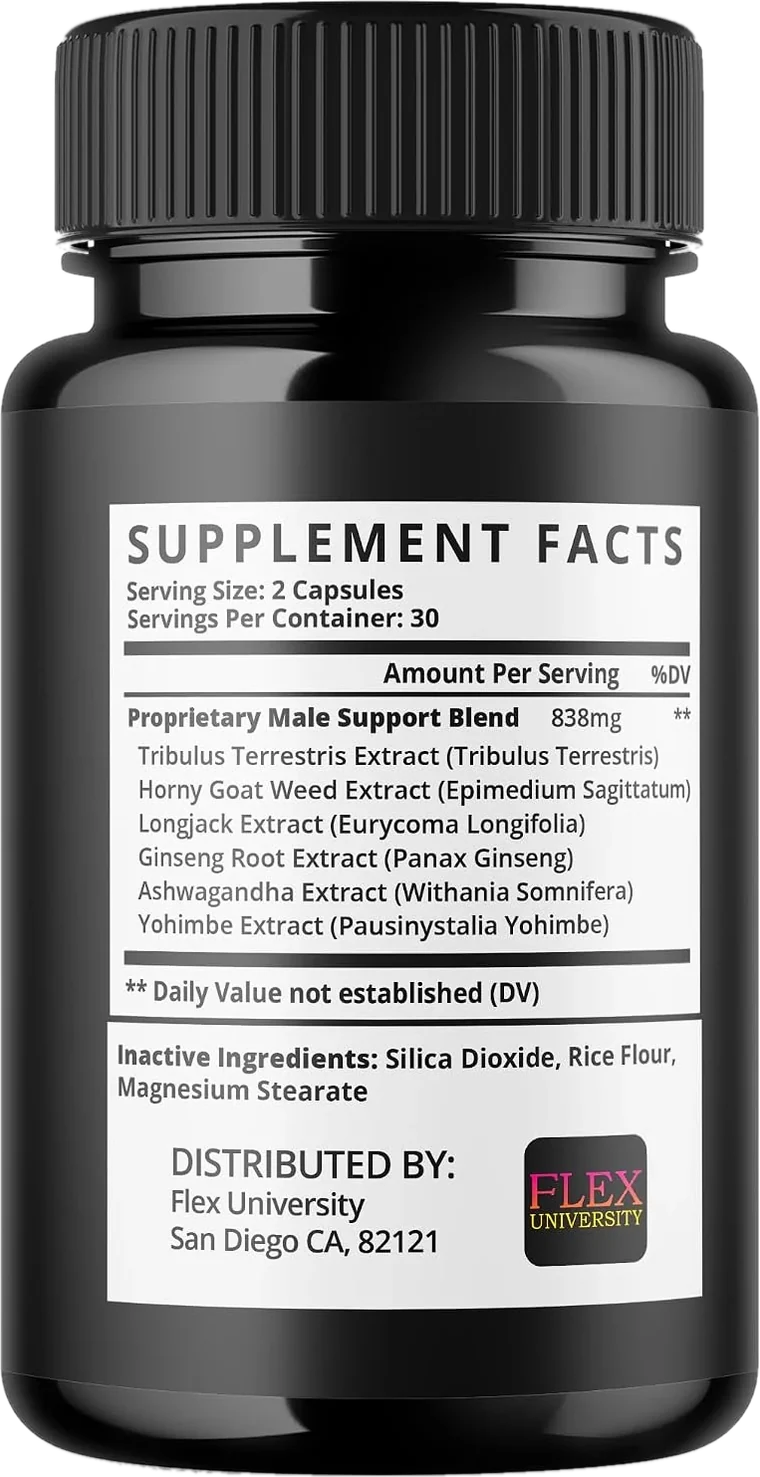
That single fact — first-by-weight but no printed dose — is the frame for everything below. The research on tribulus is dose-dependent and extract-dependent, and this label does not give you either number.
What the research says about testosterone
The most direct human test of tribulus and androgen levels comes from a controlled study of healthy young men published in the Journal of Ethnopharmacology in 2005. Researchers gave men a tribulus terrestris extract at a commonly used commercial dose and measured testosterone, dihydrotestosterone and related hormones before and after supplementation. The result, stated plainly in the paper's own title, was that the extract "does not influence the androgen production in young men." Hormone levels in the supplemented group did not differ meaningfully from the control group over the study period.
This matters because a large share of tribulus marketing leans on a "boosts testosterone" framing. The direct hormonal evidence in healthy men does not support that specific claim at typical extract doses. That does not mean tribulus does nothing — it means the mechanism, if there is one, is probably not "raises your testosterone," which is a narrower and more falsifiable claim than most marketing copy implies.
What the research says about sexual function
A separate line of research looks at sexual function rather than hormone levels directly. A prospective, randomized, double-blind, placebo-controlled study published in Actas Urológicas Españolas in 2014 tested tribulus terrestris against placebo in men with erectile dysfunction and reported improved erectile-function scores in the tribulus group compared with the placebo group over the study period.
Read those two findings side by side and the picture is more nuanced than either "it works" or "it doesn't": one controlled trial found a benefit on a validated sexual-function questionnaire without measuring hormones directly, while a separate controlled trial measuring hormones directly found no androgen effect in healthy men. Both can be true at once — a botanical can plausibly affect subjective or functional measures of sexual response through a pathway other than raising testosterone, for example via effects on nitric-oxide-mediated blood flow, which several of the mechanistic and animal studies discussed below have investigated. But it means marketing that jumps straight from "may support sexual function" to "boosts testosterone" is stitching together two different bodies of evidence that do not, on current data, point the same direction.
What the broader reviews conclude
Two review-level papers give useful context beyond individual trials. A 2020 comprehensive review in Biomolecules surveyed the phytochemical, pharmacological and toxicological literature on tribulus terrestris and described a plant with a genuinely broad range of studied compounds and animal-model effects, while also noting the field's persistent problems with extract standardization and study quality. A 2021 review in Physiological Research, focused specifically on tribulus and reproduction, likewise summarized animal and limited human data on hormone and reproductive-function control without concluding that human dose-response relationships are well established.
The consistent theme across both reviews is not "tribulus doesn't work" — it is that the evidence base is a patchwork of small trials, animal studies and in-vitro work using extracts that are rarely comparable to each other in strength or preparation. That is a very different statement than either "proven" or "debunked," and it is the honest one.
Why this matters for a proprietary blend
Every study cited above used a known extract at a known, stated dose. Apex Boost's label states a blend total but not an individual tribulus amount, so none of these findings can be mapped onto "how much you're getting" from this specific product. That is a limitation of the label, not of the research.
How tribulus is thought to work, mechanistically
Neither of the reviews above claims a single, settled mechanism, and that is worth saying plainly rather than glossing over. The Biomolecules review catalogues a wide range of compounds isolated from tribulus — steroidal saponins (protodioscin among them), flavonoids and alkaloids — and a similarly wide range of effects reported in cell and animal studies: influences on nitric-oxide pathways involved in blood flow, antioxidant activity, and effects on the hypothalamic-pituitary-gonadal axis in some animal models but not others. The Physiological Research review covers similar ground specifically for reproductive and hormonal endpoints, again mostly in animal and cell-culture systems rather than controlled human trials.
The honest summary is that tribulus has plausible biological activity worth studying — it is not an inert filler ingredient — but the step from "active in a rat model" or "active in a cell culture" to "will produce a specific, predictable effect in a man taking an undisclosed dose inside a six-herb blend" is a large one that the current human evidence does not fully close. Protodioscin content in particular varies enormously by plant source and extraction method, which is one reason the same nominal ingredient name can behave so differently from one product to the next.
Why "testosterone booster" claims deserve scrutiny
Tribulus is rarely sold alone — it is usually one ingredient in a multi-herb "testosterone booster" or "male support" formula, exactly as it is here. A 2024 systematic review published in the International Journal of Impotence Research examined the evidence behind commercially marketed testosterone-booster supplements as a category, tribulus included, and found limited high-quality clinical evidence that these over-the-counter products meaningfully raise serum total testosterone in the way their marketing implies. The review's conclusion is a useful category-level check on any product, including this one, that uses "male support" or "vitality" language without a specific, sourced hormonal claim attached.
Apex Boost's own on-pack language is comparatively restrained — the front label uses asterisked terms like "Libido," "Stamina" and "Energy" rather than an explicit testosterone claim, and the required disclaimer that these statements have not been evaluated by the FDA appears on the bottle. That framing is closer to what the systematic review would consider defensible than an unqualified "boosts testosterone" claim would be.
Why the dose is the real variable
Reading tribulus research honestly means accepting that "tribulus terrestris" is not one standardized thing. Clinical trials on tribulus have used extracts ranging from roughly 250 mg to over 1,500 mg per day, standardized to saponin content anywhere from single digits up to 60% or more depending on the manufacturer. A study using a 60%-saponin extract at 750 mg per day is not testing the same substance as a product using an unstandardized extract at an undisclosed share of an 838 mg blend.
| How it's printed | What you know | What you don't |
|---|---|---|
| "Tribulus Terrestris Extract," standardized to X% saponins, with a stated mg amount | The actual saponin dose | Little else — this is the best case for a botanical |
| "Tribulus Terrestris Extract," stated mg amount, no standardization | The weight of extract | Its actual potency |
| Inside a proprietary blend, first by weight, no amount printed | Only that it's the largest single component by weight | The actual mg amount and any standardization |
Apex Boost's label is the third row. Being listed first only means tribulus outweighs the other five botanicals combined-per-unit within that blend order — it does not tell you whether the total tribulus content is closer to a dose used in a positive trial or a token amount far below what any cited study tested.
Safety notes
Across the reviewed literature, tribulus terrestris is generally reported as well tolerated in the doses studied, with mild gastrointestinal upset being the most commonly noted side effect in human trials. It is not associated with the cardiovascular cautions that apply to yohimbe, another ingredient in this same blend. That said, "generally well tolerated in trials" is not the same as "risk-free for everyone" — the label's own caution to consult a physician before use applies fully here, particularly for anyone on medication for blood pressure or blood sugar, since some animal data has examined tribulus's effects on both.
A short checklist for reading any tribulus label
- Find the milligram amount. If it's inside an unlabeled proprietary blend, as it is here, you cannot compare it to any specific study dose.
- Look for a saponin percentage. Without one, "tribulus extract" tells you almost nothing about strength.
- Separate the testosterone claim from the sexual-function claim. The human evidence for each is different, and a label or ad that conflates them is oversimplifying.
- Check the disclaimer. A product that keeps its language to asterisked, non-specific terms is making a narrower claim than one that states a hormonal outcome outright.
- Read the whole blend, not just the first ingredient. Being listed first tells you about weight order, not about whether the dose matches a trial that showed a benefit.
See the rest of the label. The full Supplement Facts and Directions panels for Apex Boost are photographed and broken down ingredient by ingredient on the product page.
Read the label scanBottom line
Tribulus terrestris has real, published human research behind it — including at least one randomized trial reporting improved erectile-function scores and at least one controlled study finding no testosterone effect in healthy men. Both are worth knowing. What no amount of research can do is tell you how much tribulus is in a specific bottle when the label only prints a blend total. Apex Boost prints 838 mg for six herbs combined, tribulus first by weight, no individual figure disclosed. Treat any marketing claim that skips over that gap with appropriate skepticism, on this product or any other.
Keep reading
References
- Neychev VK, Mitev VI. The aphrodisiac herb Tribulus terrestris does not influence the androgen production in young men. J Ethnopharmacol. 2005;101(1-3):319-323. PMID: 15994038.
- Santos CA Jr, Reis LO, Destro-Saade R, et al. Tribulus terrestris versus placebo in the treatment of erectile dysfunction: A prospective, randomized, double blind study. Actas Urol Esp. 2014;38(4):244-248. PMID: 24630840.
- Stefanescu R, Tero-Vescan A, Negroiu A, et al. A Comprehensive Review of the Phytochemical, Pharmacological, and Toxicological Properties of Tribulus terrestris L. Biomolecules. 2020;10(5):752. PMID: 32408715.
- Sirotkin AV, Kolesárová A. Puncture vine (Tribulus Terrestris L.) in control of health and reproduction. Physiol Res. 2021;70(Suppl 4):S657-S667. PMID: 35199550.
- Morgado A, Tsampoukas G, Sokolakis I, Schoentgen N, Urkmez A, Sarikaya S. Do "testosterone boosters" really increase serum total testosterone? A systematic review. Int J Impot Res. 2024;36(4):348-364. PMID: 37697053.