GMP Certified, FDA-Registered, Third-Party Tested: What These Seals Actually Mean
None of the three seals commonly printed on supplement bottles — "GMP Certified," "FDA-registered facility" and "Third-Party Tested" — means the FDA approved the product or verified its ingredient claims. Each describes something narrower: a manufacturing-process standard, a facility registration, and an independent lab check, respectively. Apex Boost's own bottle carries versions of all three. Here is what each one legally covers, and what it doesn't.
Why these three words get confused
Walk down a supplement aisle, or scroll a product page, and you'll see some combination of "GMP Certified," "FDA Registered," "Third-Party Tested," "Non-GMO" and "Made in the USA" printed as small badges, usually without further explanation. They look like a single block of reassurance, and marketing generally wants you to read them that way. Legally and practically, they are three separate claims with three separate — and much narrower — meanings, and none of them is FDA approval, because dietary supplements as a category are not FDA-approved before they reach a shelf.
This article exists because those three specific phrases are the ones that show up most consistently across the men's-health supplement category, this product included, and because conflating them is one of the most common ways a reader ends up with more confidence in a bottle than the label actually supports. None of what follows is a claim that any particular seal is fake or that any particular manufacturer is acting in bad faith — it's a plain explanation of what each phrase is legally required to mean, so you can judge the strength of the evidence behind it yourself.
The regulatory backdrop: DSHEA
The reason supplement labeling works this way traces back to the Dietary Supplement Health and Education Act of 1994 (DSHEA), the federal law that defines how dietary supplements are regulated in the United States. Under DSHEA, supplements are regulated more like a category of food than like a drug: manufacturers are responsible for ensuring their products are safe and that label claims are truthful before marketing them, but — unlike a prescription or over-the-counter drug — a supplement does not go through FDA premarket approval for safety or effectiveness. The FDA's main enforcement tools are after a product is already on the market: inspecting manufacturing facilities against the standards described below, and taking action against products found to be adulterated, misbranded, or making illegal disease claims.
That framework is the reason the three seals below exist at all — they are largely industry's way of signaling quality within a system that does not require FDA premarket sign-off, and it's also why the specific wording of each seal matters so much more than it would for an FDA-approved drug.
What "GMP Certified" means
GMP stands for Good Manufacturing Practice. For dietary supplements, the relevant federal standard is set out in 21 CFR Part 111, the FDA's Current Good Manufacturing Practice regulation for dietary supplements. It covers things like facility cleanliness, equipment maintenance, employee training, batch recordkeeping, and testing components for identity before they go into a formula. Manufacturers are required to follow this regulation; a bottle that says "GMP Certified" is usually referencing either the manufacturer's own compliance with 21 CFR 111, or a certification from a third-party auditing body (such as NSF International) that has independently inspected the facility against GMP standards.
What GMP certification does not mean: it does not verify that the specific bottle in your hand contains the ingredients or amounts printed on its label, and it does not mean a government inspector reviewed this particular product's formula. It is a statement about the manufacturing process and the facility, not about the finished product's contents.
What "FDA-registered facility" means — and doesn't
Any facility that manufactures, processes, packs or holds food or dietary supplements for consumption in the United States is generally required to register with the FDA under the Food Safety Modernization Act and related food-facility registration rules. Registration is essentially an address book entry: it tells the FDA a facility exists and what it does, so the agency knows where to direct inspections and recalls. It is not a review or endorsement of anything the facility produces.
The claim this phrase cannot support
"FDA-registered facility" is sometimes displayed or implied in a way that suggests the FDA reviewed and approved the product. It did not. Registration is administrative, not evaluative. The FDA itself has published guidance warning that facility registration should not be presented as a form of FDA approval.
What "Third-Party Tested" can and can't mean
This is the vaguest of the three phrases because "tested for what, by whom, using what standard" is rarely specified on the front of a bottle. In the best case, it means an independent laboratory — unaffiliated with the manufacturer — tested finished-product samples for identity (is the ingredient what the label says it is), potency (is the labeled amount actually present), and contaminants (heavy metals, microbial contamination, and for some categories, banned substances for athletes). Organizations like NSF International, USP, and Informed Sport run recognized third-party certification programs with published standards.
In the weakest case, "third-party tested" can mean a single lab checked a single sample one time for one narrow thing — say, heavy metals only — and the claim is printed without disclosing the scope, the lab's name, or a certificate number a consumer could look up. Both scenarios can honestly be described as "third-party tested." That is exactly why the phrase alone, without a named certifying body or a verifiable certificate, tells you less than it appears to.
Why label accuracy is worth checking at all
This isn't a hypothetical concern. Independent laboratory surveys of commercial dietary supplements have repeatedly found gaps between what a label states and what a finished product actually contains. A 2024 study in Nutrients analyzed the label accuracy and quality of weight-loss dietary supplements sold on or near U.S. military bases and documented discrepancies between labeled and measured ingredient content in a meaningful share of the products tested. That study looked at a different supplement category than this one, but its core finding — that a printed label and a lab-verified content analysis do not always match — is a category-wide reason third-party testing exists in the first place, and a reason to treat any unverifiable testing claim with some caution.
A related 2026 paper in The Journal of Nutrition proposed a conceptual framework for what it called "ingredient-interpretation gaps" in food supplements — essentially, the systematic ways consumers misread supplement labels, including assuming that a listed ingredient's presence implies a specific, effective dose, or that a compliance seal implies content verification. That framework maps closely onto proprietary-blend labeling specifically: a blend total without individual amounts is a textbook example of information that is technically disclosed but practically uninterpretable without more detail.
A related distinction: structure/function claims vs. disease claims
While on the subject of what DSHEA does and doesn't allow, it's worth understanding one more regulatory line that shows up constantly on supplement packaging: the difference between a "structure/function claim" and a "disease claim." A structure/function claim describes how an ingredient affects the normal structure or function of the body — phrases like "supports libido," "promotes energy" or "supports overall wellness" fall into this category, and they are the only kind of claim DSHEA allows a supplement to make without FDA premarket review, provided the required disclaimer ("These statements have not been evaluated by the FDA...") appears alongside them.
A disease claim — stating or implying that a product diagnoses, treats, cures or prevents a specific disease, such as "treats erectile dysfunction" or "lowers blood pressure" — crosses into drug-claim territory and is not legal for a dietary supplement to make, regardless of what seals or certifications appear on the same bottle. This is why supplement copy is so consistently full of asterisked, softened language ("Libido*," "Stamina*," "Energy*") rather than direct medical claims: it is not marketing timidity, it is the legal boundary DSHEA draws around this entire product category. A bottle that stays inside structure/function language is operating inside the rules; one that starts naming specific medical conditions it treats is not, no matter how many quality seals sit next to the claim.
What's actually printed on the Apex Boost bottle
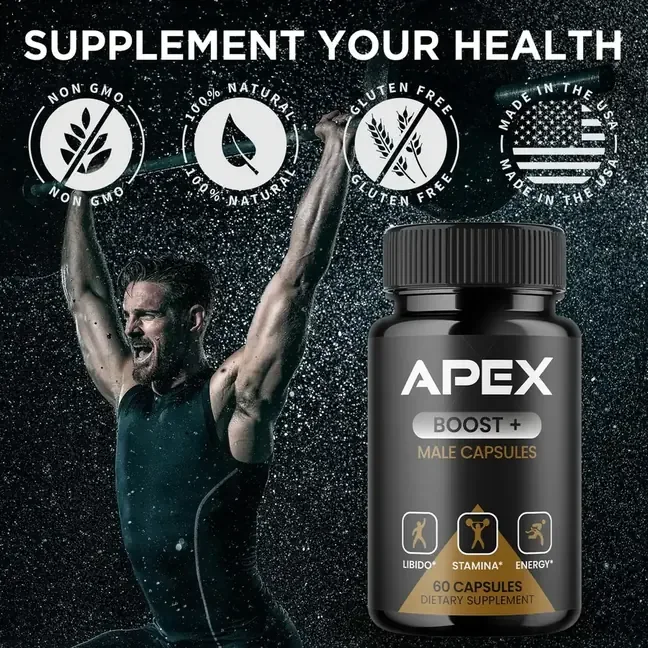
Apex Boost's own packaging carries a GMP mark, an FDA-registered-facility reference, and a third-party-tested mark, alongside "Made in USA" and ingredient-origin badges. None of these marks, individually or together, states a specific certifying body, a certificate number, or the scope of what was tested — which is common in this product category and not unique to this brand, but it does mean a reader cannot verify the specifics of any of the three claims from the bottle alone. What the label does disclose clearly is the finished-product basics: 2 capsules per serving, 30 servings per bottle, an 838 mg Proprietary Male Support Blend, and three named inactive ingredients (silica dioxide, rice flour, magnesium stearate).
Side-by-side: what each seal proves
| Claim | What it actually verifies | What it does not verify |
|---|---|---|
| GMP Certified | The manufacturing facility follows process standards (21 CFR 111) for cleanliness, recordkeeping and component checks | The exact contents of your specific bottle |
| FDA-registered facility | The facility is on file with the FDA as required by food-facility registration rules | That the FDA reviewed, tested or approved the product |
| Third-party tested | An outside lab checked something about a sample, at some point | What was tested, by whom, and whether every batch is covered — unless a named body and certificate are given |
| "Not evaluated by the FDA" disclaimer | A required disclosure that the product's structure/function claims (e.g., "supports libido") were not FDA-reviewed | Nothing about safety or accuracy either way — it's a required legal disclaimer, not a warning specific to this product |
A short checklist for reading any supplement's seals
- Look for a named certifying organization (NSF, USP, Informed Sport) rather than a generic "third-party tested" badge with no attribution.
- Look for a certificate or batch number you can verify on the certifying body's own website, not just the manufacturer's.
- Remember GMP describes the facility's process, not your bottle's exact contents.
- Remember FDA registration is an address, not an endorsement.
- Treat "not evaluated by the FDA" as a standard legal disclaimer that applies to essentially every supplement structure/function claim, not a red flag unique to one product.
- When a proprietary blend hides individual doses, no seal — GMP, FDA-registered, or third-party tested — restores that missing information. They are separate issues.
See where these seals appear on the bottle. The full Supplement Facts and quality-mark panels for Apex Boost are photographed on the product page.
Read the label scanBottom line
"GMP Certified," "FDA-registered facility" and "Third-party tested" are three real, meaningful but narrow claims, not synonyms for "FDA approved" — a status dietary supplements do not carry under DSHEA regardless of what marks appear on the label. GMP speaks to manufacturing process, facility registration speaks to being on file with the FDA, and third-party testing speaks to an outside check whose value depends entirely on who did it and what they actually tested. Reading a label well means checking which of these claims is backed by a named, verifiable body — on this bottle or any other — rather than treating three small badges as one blanket assurance.
Keep reading
References
- U.S. Food and Drug Administration. Dietary Supplement Health and Education Act of 1994 (Public Law 103-417). fda.gov/food/dietary-supplements.
- 21 CFR Part 111 — Current Good Manufacturing Practice in Manufacturing, Packaging, Labeling, or Holding Operations for Dietary Supplements. ecfr.gov.
- Crawford C, Avula B, Lindsey A, et al. Label Accuracy and Quality of Select Weight-Loss Dietary Supplements Sold on or near US Military Bases. Nutrients. 2024;16(24):4368. PMID: 39770990.
- Alsawadi A, et al. The Perception Filler: A Proposed Conceptual Framework for Ingredient-Interpretation Gaps in Food Supplements. J Nutr. 2026 Aug 27. PMID: 42660500.